Getting Started#
[35]:
from GaiaAlertsPy import alert as gaap

import numpy as np
from astropy.stats import sigma_clip
import matplotlib.pyplot as plt
%matplotlib inline
%config InlineBackend.figure_format = "retina"
from matplotlib import rcParams
rcParams['savefig.dpi'] = 550
rcParams['font.size'] = 20
plt.rc('font', family='serif')

# fancy plotting
import seaborn as sns
pal = sns.color_palette('magma', 80)
hex_colors = pal.as_hex()
Query all Gaia Photometric Science Alerts to Date#
[6]:
table = gaap.all_sources() # query and download all Gaia Photometric Science Alerts
[5]:
table
[5]:
| Name | Date | RaDeg | DecDeg | AlertMag | HistoricMag | HistoricStdDev | Class | Published | Comment | TNSid |
|---|---|---|---|---|---|---|---|---|---|---|
| str9 | str19 | float64 | float64 | float64 | float64 | float64 | str14 | str19 | str130 | str10 |
| Gaia24byo | 2024-07-21 08:45:07 | 189.20586 | 6.84128 | 18.44 | -- | -- | unknown | 2024-07-24 21:12:16 | candidate SN near galaxy WISEA J123649.31+065027.9 | AT2024poq |
| Gaia24byn | 2024-07-21 00:34:35 | 32.8506 | 46.70412 | 18.3 | -- | -- | unknown | 2024-07-24 21:11:26 | Apparently hostless transient | AT2024knb |
| Gaia24bym | 2024-07-21 20:00:19 | 211.39828 | -39.20317 | 18.48 | -- | -- | SN | 2024-07-24 21:10:36 | confirmed SN in galaxy IC 4367 | SN2024pfc |
| Gaia24byl | 2024-07-21 13:37:09 | 233.02488 | -60.3525 | 18.7 | -- | -- | unknown | 2024-07-24 21:09:46 | blue transient in the galactic plane | AT2024qah |
| Gaia24byk | 2024-07-21 15:21:38 | 172.17452 | 42.52083 | 18.86 | 19.34 | 0.11 | QSO | 2024-07-24 21:08:56 | slow brightening in known QSO | AT2024qag |
| Gaia24byj | 2024-07-21 05:07:36 | 23.56687 | 30.61165 | 17.47 | 17.97 | 0.15 | unknown | 2024-07-24 21:08:06 | Brightening in Gaia and GALEX source | AT2020aafy |
| Gaia24byi | 2024-07-21 19:29:51 | 248.02041 | -64.88373 | 18.72 | 19.48 | 0.21 | unknown | 2024-07-24 21:07:04 | Brightening of a Gaia and WISE source | AT2024qaf |
| Gaia24byh | 2024-07-20 18:07:05 | 1.79692 | -19.91794 | 18.94 | 19.28 | 0.09 | unknown | 2024-07-24 11:49:06 | Brightening in Gaia and Wise source | AT2024pzq |
| Gaia24byg | 2024-07-20 22:53:27 | 29.21525 | 42.50217 | 17.41 | 20.28 | 0.15 | unknown | 2024-07-24 11:43:54 | 2.5 mag brightening in candidate CV TCP J01565167+4230076 | AT2024moh |
| Gaia24byf | 2024-07-20 10:37:26 | 38.2396 | 55.66286 | 17.88 | 19.13 | 0.59 | unknown | 2024-07-24 11:41:44 | 1.5 mag brightening in candidate CV | AT2024pzp |
| ... | ... | ... | ... | ... | ... | ... | ... | ... | ... | ... |
| Gaia14aaj | 2014-09-12 15:40:38 | 187.7021 | 46.96982 | 18.98 | 19.56 | 0.1 | unknown | 2014-10-13 14:29:00 | -- | -- |
| Gaia14aai | 2014-08-30 11:57:30 | 23.88339 | -20.40796 | 19.18 | 19.7 | 0.08 | unknown | 2014-10-13 14:29:00 | -- | -- |
| Gaia14aah | 2014-08-26 19:42:12 | 210.45337 | 54.5133 | 18.0 | 18.51 | 0.06 | unknown | 2014-10-13 14:29:00 | -- | -- |
| Gaia14aag | 2014-08-22 15:17:46 | 219.14335 | 44.65261 | 17.75 | 18.42 | 0.02 | unknown | 2014-10-13 14:29:00 | -- | -- |
| Gaia14aaf | 2014-08-17 21:35:53 | 244.25381 | 62.00685 | 17.05 | 18.06 | 0.19 | CV | 2014-10-13 14:29:00 | -- | -- |
| Gaia14aae | 2014-08-11 13:43:26 | 242.89156 | 63.14217 | 16.04 | 17.56 | 0.2 | CV | 2014-10-13 14:29:00 | -- | -- |
| Gaia14aad | 2014-08-08 01:17:01 | 209.68122 | 48.70098 | 18.28 | 18.85 | 0.02 | unknown | 2014-10-13 14:29:00 | -- | -- |
| Gaia14aac | 2014-08-02 07:19:24 | 214.66744 | 56.46959 | 18.68 | 19.55 | 0.05 | unknown | 2014-10-13 14:29:00 | -- | -- |
| Gaia14aab | 2014-07-27 19:10:29 | 206.91011 | 55.54871 | 19.11 | 20.0 | 0.1 | unknown | 2014-10-13 14:29:00 | -- | -- |
| Gaia14aaa | 2014-08-30 02:22:31 | 200.25961 | 45.53943 | 17.32 | 19.22 | 0.42 | SN Ia | 2014-09-12 09:00:00 | -- | -- |
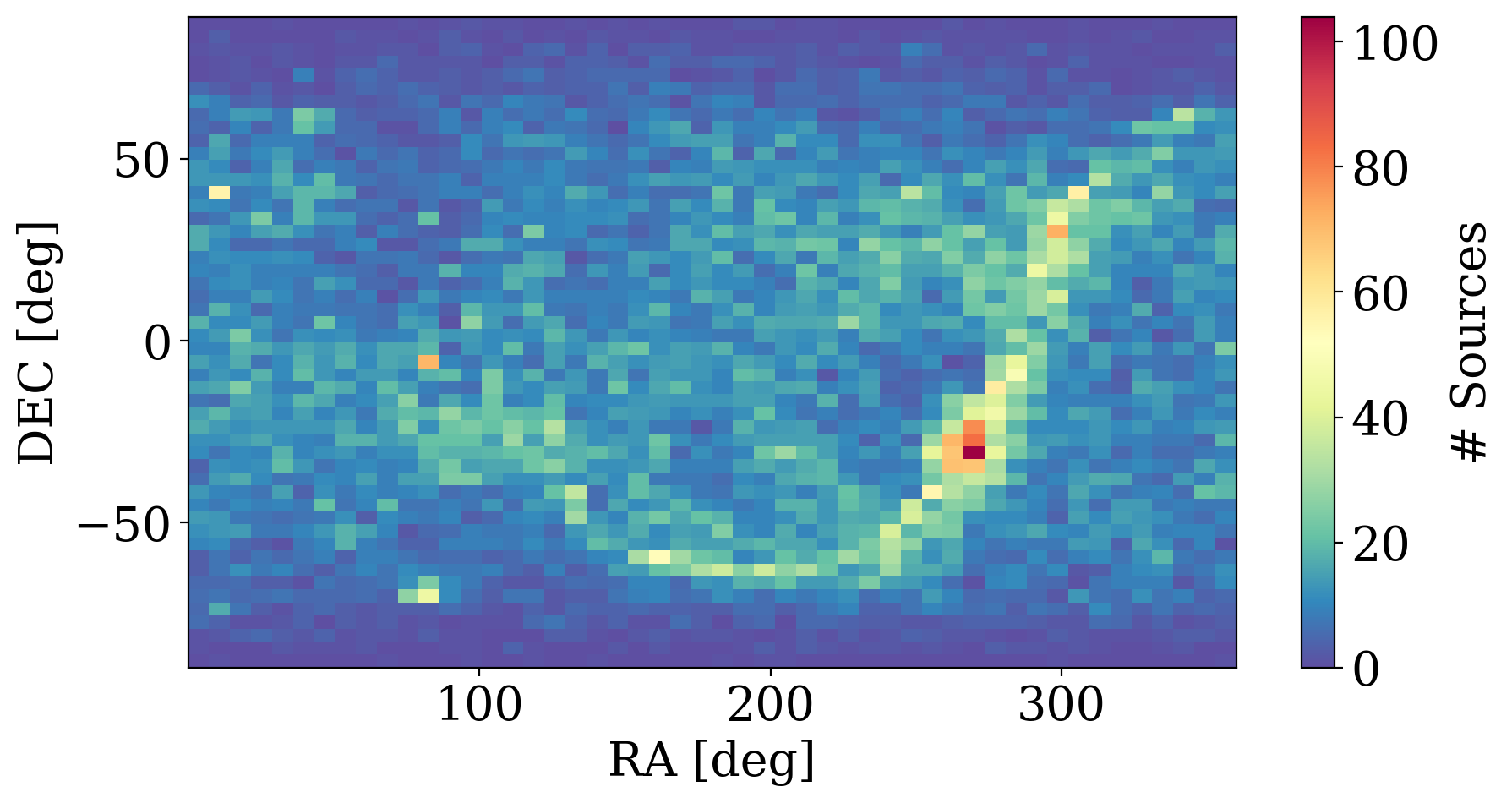
Sky Distribution of Alerts#
[6]:
plt.figure(figsize=(10,5))
_ = plt.hist2d(table['RaDeg'], table['DecDeg'], bins=(50, 50), cmap='Spectral_r')
plt.colorbar(label='# Sources')
plt.xlabel("RA [deg]")
plt.ylabel("DEC [deg]")
[6]:
Text(0, 0.5, 'DEC [deg]')
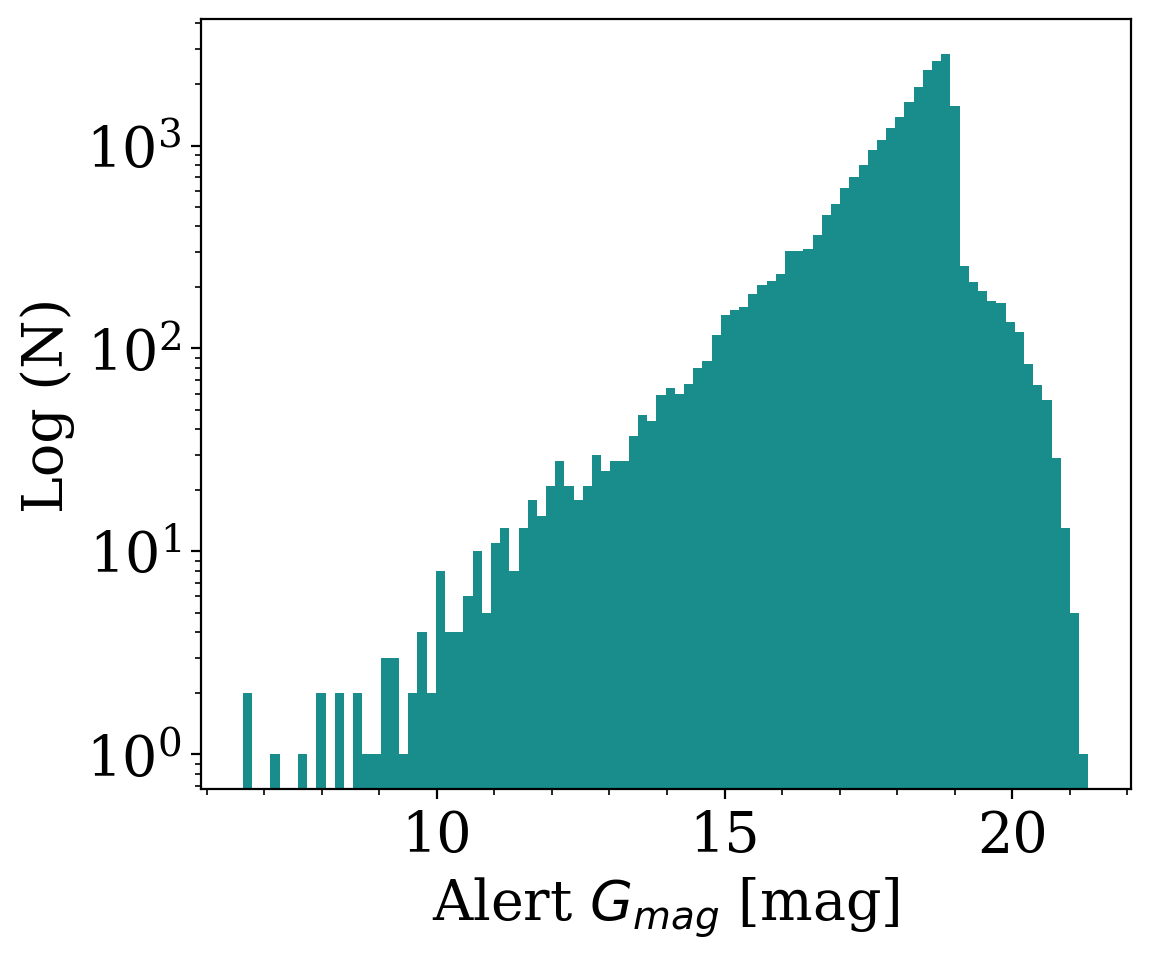
Histogram of All Alert Magnitudes#
[11]:
plt.figure(figsize=(6,5))
_ = plt.hist(table['AlertMag'], histtype='stepfilled', color='teal', bins='scott', alpha=0.9)
plt.yscale('log')
plt.ylabel("Log (N)")
plt.xlabel("Alert $G_{mag}$ [mag]")
plt.minorticks_on()
Getting Started with Alert Light Cuves#
In this short tutorial you will learn how to use GaiaAlertsPy and query the alert light curves. Once you query a Gaia Alerts, it will return a astropy.Table containing the epochal photometry.
[7]:
target_id = "Gaia22eoa"
alert_lc = gaap.GaiaAlert(target_id).query_lightcurve_alert()
[16]:
# view first 5 alerts
alert_lc[0:5]
[16]:
| JD | mag_G | mag_G_error |
|---|---|---|
| float64 | float64 | float64 |
| 2457107.4551157407 | 16.7 | 0.015068630569774477 |
| 2457131.1310416665 | 16.89 | 0.01568925719710279 |
| 2457268.409351852 | 16.81 | 0.015420801849645116 |
| 2457298.7162152776 | 17.0 | 0.016077223994238388 |
| 2457319.6403819444 | 16.98 | 0.016004964926408682 |
The photometric uncertainties are calculated using the following equation and are valid for 13<G<21:
For more information please see Gaia Early Data Release 3. Gaia photometric science alerts.
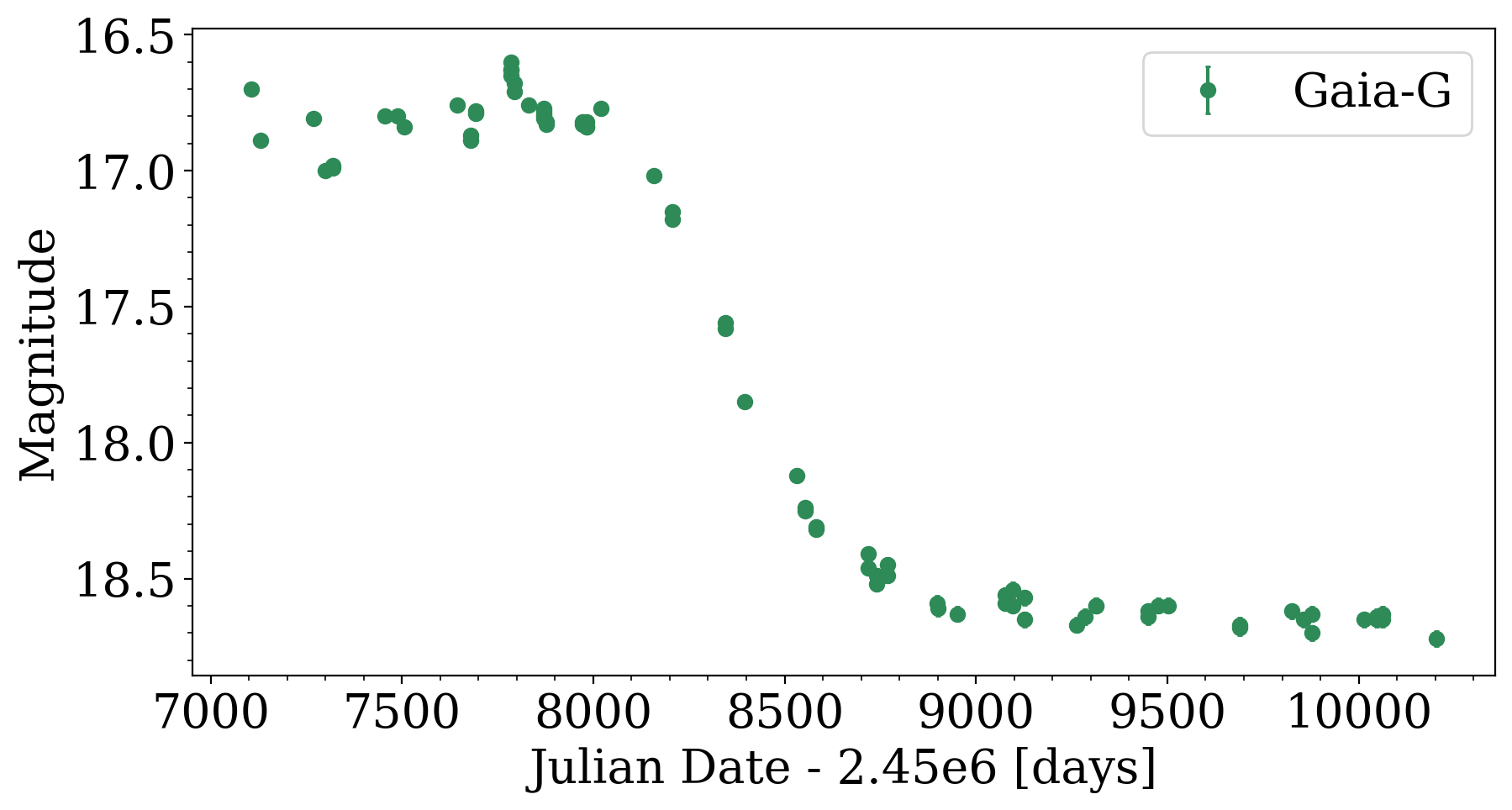
Let’s plot the light curve of this interesting Young Stellar Object:
[8]:
fig, ax = plt.subplots(nrows=1, ncols=1, figsize=(10,5))
ax.errorbar(alert_lc['JD']-2.45e6, alert_lc['mag_G'], alert_lc['mag_G_error'], fmt='o', capsize=1, color='seagreen',
label='Gaia-G')
ax.legend()
ax.set_ylim(ax.set_ylim()[::-1])
ax.set_xlabel("Julian Date - 2.45e6 [days]")
ax.set_ylabel("Magnitude")
plt.minorticks_on()
Accessing the BP-RP Low-Res. Spectra#
For the moment we suggest that the spectra for each band is summed and the zero-point for each filter to be applied when converting from the raw ADU to the AB magnitude system. Further investigation will examine the calibration between standard stars and calibrating the ADU spectra to more reliable zero-point estimations and other systematics.
Warning – this is a very crude estimate to convert the BP/RP spectra to BP/RP magnitudes. More tutorials and methods for calibration will come soon!
Let’s first fetch all the BP/RP photometry:
[9]:
# Now we can even query the BP_RP information
color_lc = gaap.GaiaAlert(target_id).query_bprp_history()
[11]:
color_lc[0:5]
[11]:
| Date | JD | Average Mag. | order | bp | rp | Name |
|---|---|---|---|---|---|---|
| str19 | float64 | float64 | int64 | float64[60] | float64[60] | str9 |
| 2015-03-25 22:55:22 | 2457107.46 | 16.7 | 0 | 0.0 .. 14.0 | 0.019 .. -2.419 | Gaia22eoa |
| 2015-04-18 15:08:42 | 2457131.13 | 16.89 | 1 | 1.2061 .. -0.2061 | 0.2057 .. -5.2057 | Gaia22eoa |
| 2015-09-02 21:49:29 | 2457268.41 | 16.81 | 2 | 1.9246 .. -2.3246 | 0.5859 .. -1.3859 | Gaia22eoa |
| 2015-10-03 05:11:22 | 2457298.72 | 17.0 | 3 | 2.9471 .. -0.5471 | 0.238 .. -3.038 | Gaia22eoa |
| 2015-10-24 03:22:10 | 2457319.64 | 16.98 | 4 | -1.6875 .. 8.0875 | -1.029 .. -4.771 | Gaia22eoa |
Now we can estimate a very approximate magnitude for each bp/rp spectrum using the instrumental zero-point values:
[29]:
# Instrumental zero-point values
zp_BP, zp_RP = 25.3514, 24.7619 # Table 5.2 (https://gea.esac.esa.int/archive/documentation/GDR2/Data_processing/chap_cu5pho/sec_cu5pho_calibr/ssec_cu5pho_calibr_extern.html)

bp_mag, rp_mag = [], []
for _lc in color_lc:
    bp0, rp0 = _lc['bp'], _lc['rp']

    # Count only positive ADU counts & apply 5-sigma clip (see Hodgkin et al. 2021; Section 3.6)
    bp, rp = sigma_clip(bp0[bp0>0], sigma=5), sigma_clip(rp0[rp0>0], sigma=5)

    # Convert total flux to magnitudes
    bp_mag.append(-2.5*np.log10(bp.sum()) + zp_BP)
    rp_mag.append(-2.5*np.log10(rp.sum()) + zp_RP)
Time Series BP RP Spectra#
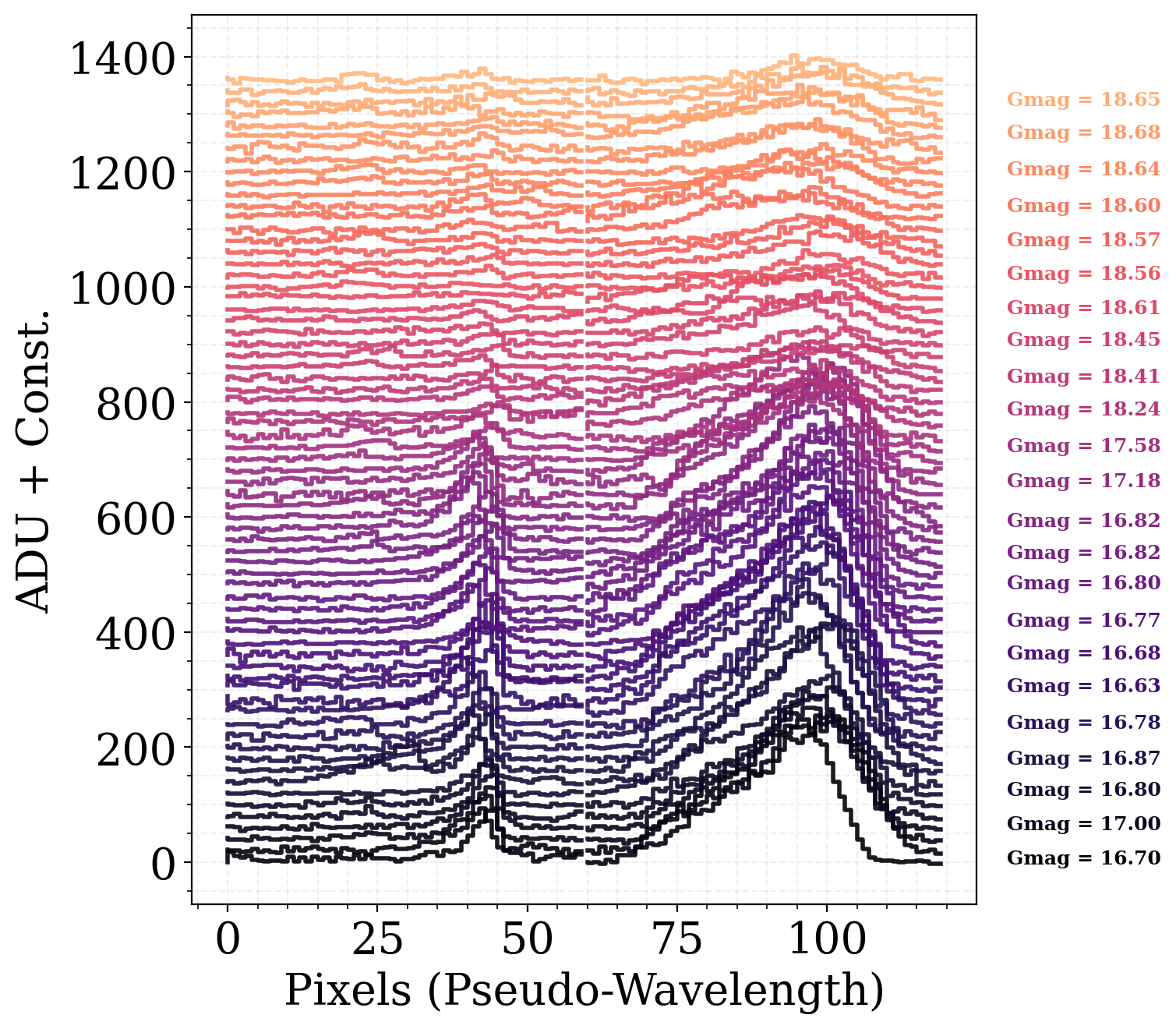
Alternatively, we can also fetch the raw ADU spectra that are reported on the GSA website. Same drill as before. These spectra are not calibrated - however some crude clolors can be extracted if you know the SED if your soruce.
Supposed we wanted to see the overall change in the low-res BP/RP spectra as a function of time and Gaia G magnitude. We can make a nice visualization combining the epochal BP/RP spectra including the average G band magnitude. From the plot below, we can see how for this particular souce that its spectrum is mostly red!
Please see the epochal BP/RP tutorial for more details!
[36]:
plt.figure(figsize=(8, 7))

# Plotting each color light curve
for i, c in enumerate(color_lc):
    offset = i * 20
    color = hex_colors[i % len(hex_colors)]

    # Plot BP and RP light curves with offset
    plt.step(range(0, 60), c['bp'] + offset, color=color, alpha=0.9, lw=2)
    plt.step(range(60, 120), c['rp'] + offset, color=color, alpha=0.9, lw=2)

    # Annotate with average magnitude every third curve
    if i % 3 == 0:
        plt.text(130, np.min(c['rp']) + offset, f"Gmag = {c['Average Mag.']:.2f}", fontsize=9, color=color, weight='bold')

# Labels and grid
plt.ylabel("ADU + Const.")
plt.xlabel("Pixels (Pseudo-Wavelength)")
plt.minorticks_on()
plt.grid(which='both', linestyle='--', alpha=0.2)

plt.tight_layout()
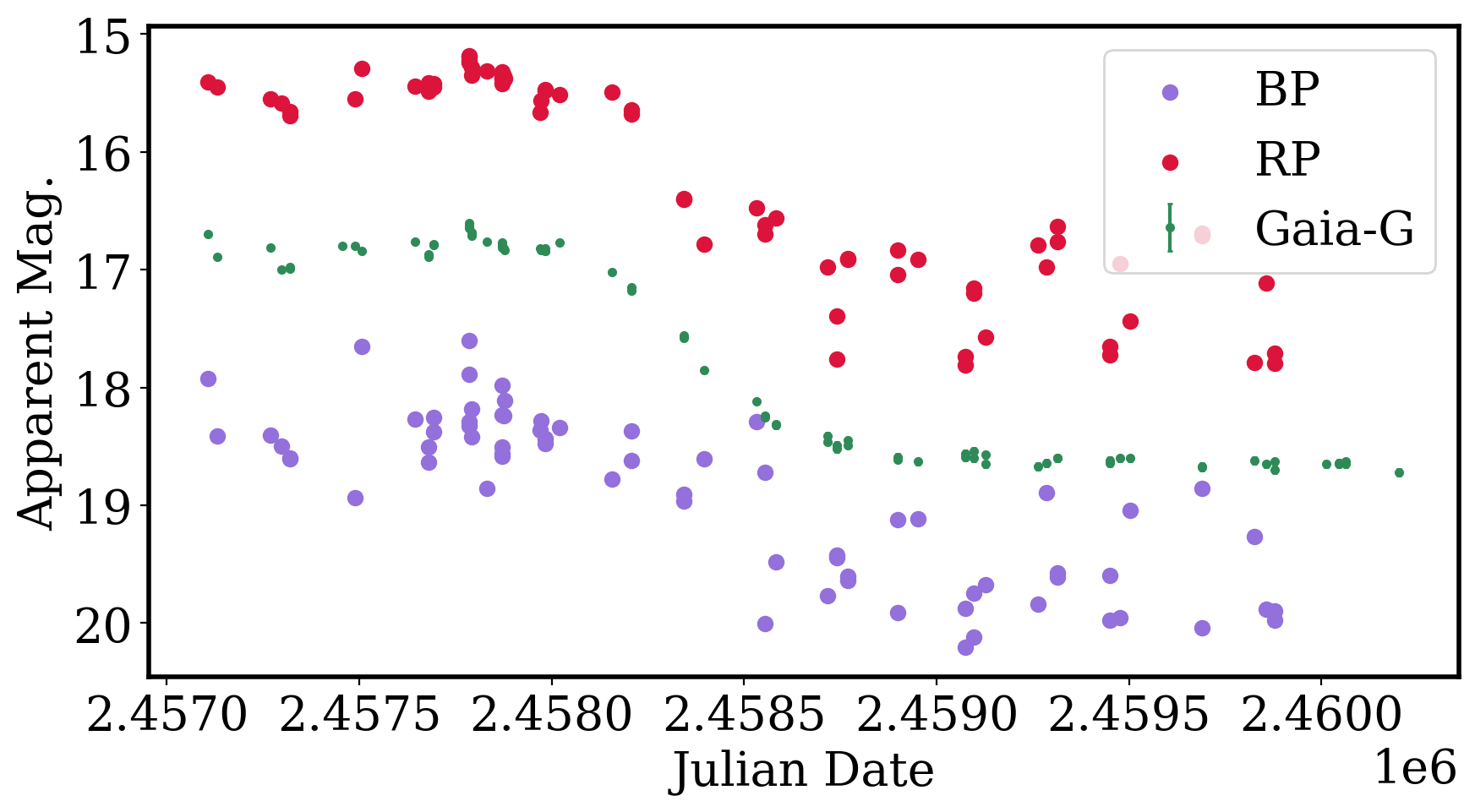
Using the extrapolated BP/RP colors we can now plot the BP and RP light curves to see if our object of interest has any color evolution:
[33]:
fig, ax = plt.subplots(nrows=1, ncols=1, figsize=(10,5))
ax.errorbar(alert_lc['JD'], alert_lc['mag_G'], alert_lc['mag_G_error'], fmt='.', capsize=1, color='seagreen',
label='Gaia-G')
ax.scatter(color_lc['JD'], bp_mag, color='mediumpurple', label='BP')
ax.scatter(color_lc['JD'], rp_mag, color='crimson', label='RP')
ax.legend()
ax.set_ylim(ax.set_ylim()[::-1])
ax.set_xlabel("Julian Date")
ax.set_ylabel("Apparent Mag.")
[33]:
Text(0, 0.5, 'Apparent Mag.')